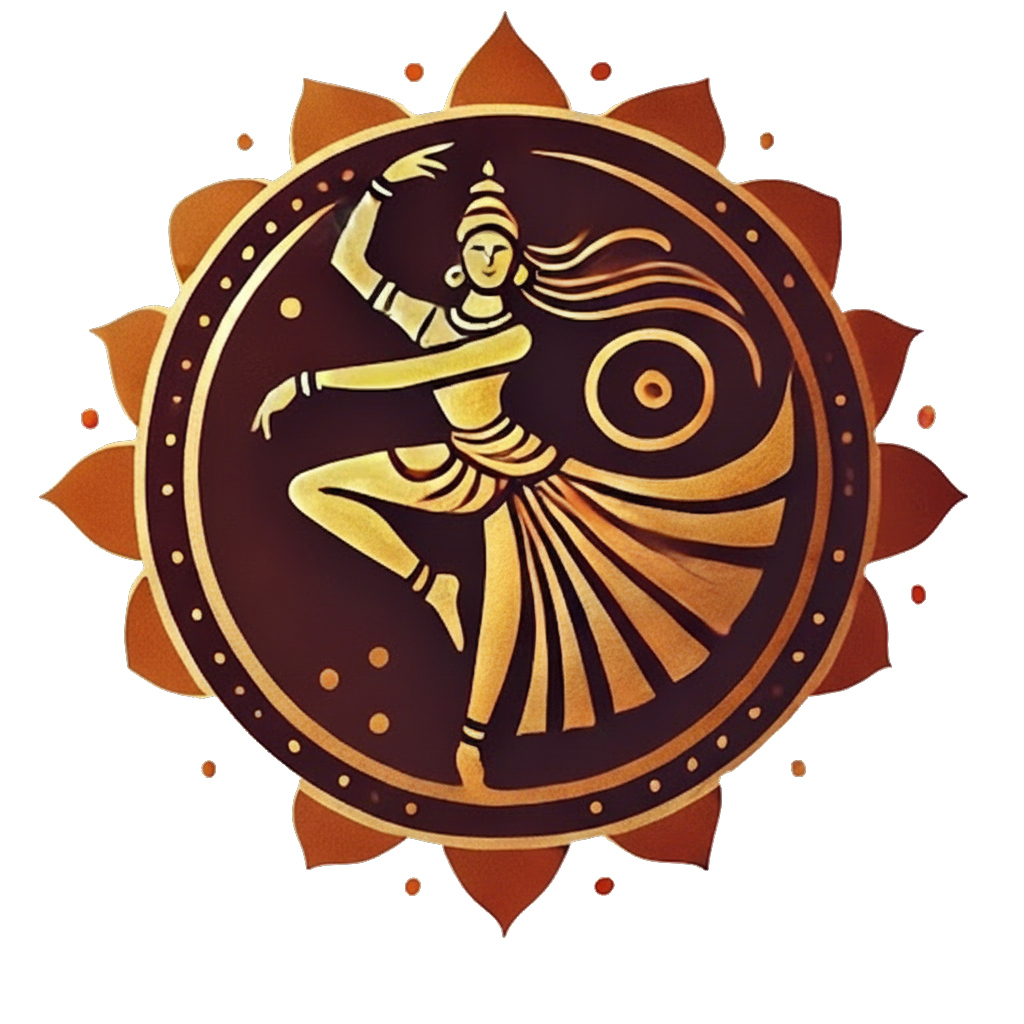

Bharatanatyam, one of the oldest and most revered classical dance forms of India, has continuously evolved through the visions of its dedicated practitioners. Chithvilasa Bani represents a profound contemporary evolution of this art form, conceptualized and rigorously researched by the Natyacouple, Aarjith and Aparna. Firmly rooted in the precise and disciplined Kalakshetra tradition established by Smt. Rukmini Devi Arundale, Chithvilasa transcends mere physical performance. It serves as a vital bridge between the striking geometry of physical form and the expansive depth of internal, meditative awareness. At its core, Chithvilasa Bani is an exploration of duality harmonizing the unseen mind with the tangible body, and the masculine with the feminine translating them into a seamless vocabulary of movement.
The Foundational Philosophy: Chit and Vilasa
The quintessential philosophy of this style is encapsulated in the following sacred verse, which serves as the bedrock of the bani:
This sloka deconstructs the very fabric of existence through the lens of dance:
- Chit represents the unseen inner consciousness, the mind, and the latent internal spiritual energy. It is the formless essence that drives all creation.
- Vilasa represents the physical manifestation, the tangible exterior, the dynamism of outward energy, and the playful nature of the universe.
- Jagath Roopam signifies the form of the universe itself, which is born from the perfect, harmonious blend of Chit and Vilasa.
- Natarajasya Nrithyathah compares this equilibrium to the cosmic, ecstatic dance of Lord Nataraja.
Just as the universe relies on a delicate balance between unseen forces and physical matter to sustain life, Chithvilasa Bani seeks to manifest this perfect mind-body synergy on stage. The dancer becomes a microcosm of the universe.
Cosmic Resonance: Nataraja and the Dance of Subatomic Matter
To fully grasp Chithvilasa, one must look toward the imagery of Shiva Nataraja. Shiva’s cosmic dance occurs within a ring of fire, the prabha mandala, symbolizing the continuous, cyclical nature of time without beginning or end. Within this fiery cosmos, Nataraja performs the five foundational acts (Pancha Kritya): Srishti (creation), Sthiti (preservation), Samhara (destruction), Tirobhava (illusion), and Anugraha (grace/emancipation). Nataraja's dance is the basis of all existence, reminding humanity that worldly forms are fluid, illusory, and ever-changing.
This ancient mythological framework astonishingly mirrors modern scientific paradigms, particularly quantum field theory. Modern physics has revealed that every subatomic particle is engaged in a continuous, pulsating energy dance of creation and destruction. The modern physicist and the ancient mystic observe the same truth: Shiva’s dance is the dance of subatomic matter. In recognition of this profound intersection between mythology and science, a majestic bronze statue of Nataraja stands at CERN in Switzerland, the global epicenter of particle physics. Chithvilasa Bani embodies this intersection, acknowledging that the dancer’s kinetic energy on stage is a direct reflection of the universe's fundamental particles in motion.
Ardhanarishvara: The Unity of Opposites
Another central pillar of Aarjith and Aparna’s vision for Chithvilasa Bani is the total synchronization of the masculine and feminine forms within the dancer. Drawing inspiration from the concept of Ardhanarishvara, the Lord who is half woman, this style delves into the biological and psychological balance of the X and Y chromosomes.
Ardhanarishvara symbolizes the inseparable unity of Purusha (the cosmic male principle/consciousness) and Prakriti (the cosmic female principle/nature). It harmonizes conflicting ways of life: the spiritual asceticism of Shiva and the materialistic grounding of Parvati. Biologically and psychologically, no human being is entirely unisexual; everyone carries the potential and neurohormonal mechanisms of both masculine and feminine traits. While the modern world aspires to resolve the paradox of opposites through psychological unity, Chithvilasa Bani physically actualizes it through art.
The Dancer as a Neutral Medium and the Rasika’s Trance
In the Chithvilasa style, Aarjith and Aparna perform in tandem with a specific focus: the dancer is not viewed as a performer bound by a specific gendered roopa (form), but rather as an "empty vessel" or a neutral medium. On stage, this vessel contains an inseparable blend of masculinity and femininity.
This approach systematically dismantles rigid cultural expectations the notion that nurturing is exclusively for women, or assertiveness exclusively for men. Instead, Chithvilasa focuses on Ethical Equilibrium, physically pairing the "virtues of the heart" (mercy, grace, tenderness) with the "virtues of action" (justice, courage, power).
When a Rasika (audience member) witnesses this, they are guided into a trance-like state. Stripped of their inherent biases, they can no longer distinguish or isolate the male or female traits within the choreography. Instead of seeing a man or a woman, the audience witnesses the complete, undivided spectrum of human nature.
Conclusion
Chithvilasa Bani ultimately transcends the pursuit of balance as mere proportion; it envisions a state of totality. It is not a negotiation of halves, but a simultaneous fullness, where Chit and Vilasa, the masculine and the feminine, the inner and the outer, each exist in their complete intensity while dissolving into one unified field of expression. In this state, dualities are not reduced but exalted, not compromised but consummated. The dancer, therefore, ceases to be an individual performer and becomes a living axis where consciousness takes form and form returns to consciousness, a dynamic continuum echoing the eternal rhythm of Nataraja’s cosmic dance. What emerges on stage is not choreography alone, but a living philosophy: a kinetic manifestation of the universe’s deepest truth that apparent opposites are, in essence, inseparable complements. In its highest realization, Chithvilasa Bani offers more than aesthetic experience; it becomes a transformative encounter. For the Rasika, it is an invitation to perceive beyond binaries and inhabit wholeness. For the dancer, it is a path of embodied inquiry and transcendence. And for Bharatanatyam itself, it stands as a luminous evolution where tradition is not merely preserved, but expanded into a profound, universal language of unity, consciousness, and cosmic harmony.